
Private psychotherapy for adults in Dartford
Online Psychotherapy for Dartford
Adults living or working in Dartford can access private individual psychotherapy online or by telephone, without needing to travel to a consulting room.
The work is informed by a systemic and relational perspective, which means difficulties can be explored in relation to relationships, family, identity, work and wider life context rather than only as isolated symptoms.
Sessions are delivered remotely. This page is for adults in Dartford seeking online or telephone psychotherapy and does not represent a physical psychotherapy clinic or consulting room in Dartford.
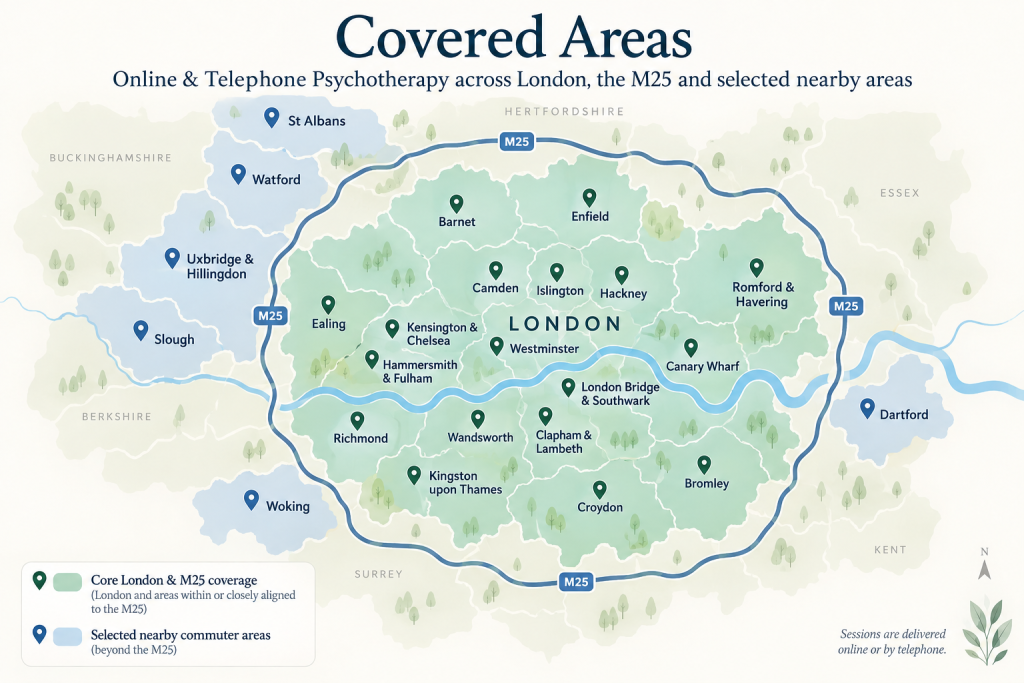
Dartford & north-west Kent
Psychotherapy that can fit around life in Dartford
Travelling to and from a regular psychotherapy appointment can add time and complexity to an already full week.
For some people in Dartford, online psychotherapy offers a way to create a consistent private space for therapy without adding another journey. This may be useful alongside work, family commitments, caring responsibilities, accessibility needs or a preference for greater privacy.
Working remotely
Online psychotherapy can still be relational
The medium is different from meeting in the same physical room, but many central elements of psychotherapy can still be present.
Space to think aloud
Sessions can provide structured time to describe what is happening, notice what feels difficult and consider what may need attention.
Patterns can be explored
Current relationships, family expectations, trust, conflict, closeness and distance may all become relevant.
The wider picture matters
Work, culture, identity, family roles, life stage and wider circumstances may be considered alongside emotional experience.
Why remote therapy
Why some people choose online psychotherapy
Practical convenience is one factor, but not the only reason someone may prefer to work remotely.
- Less travel around Dartford or north-west Kent
- Easier scheduling around work or family commitments
- Fewer logistical demands around regular appointments
- A familiar private environment
- Potentially easier continuity during busy periods
- Telephone as an alternative to video
Reasons people seek psychotherapy
What might bring someone to psychotherapy?
You do not need a diagnosis or one perfectly defined problem to begin considering psychotherapy.
Anxiety & worry
Persistent worry, uncertainty or difficulty settling mentally.
Explore anxiety & worryStress & overwhelm
Feeling stretched by competing demands, pressure or change.
Explore stress & overwhelmBurnout & perfectionism
High standards, over-responsibility or difficulty stepping back.
Explore burnoutRelationship patterns
Recurring conflict, distance, responsibility or familiar relational roles.
Explore relationship patternsFamily relationships
Difficult roles, expectations, loyalty, conflict or changing family dynamics.
Explore family relationshipsLoneliness & disconnection
Feeling distant from others, unseen or disconnected even when not physically alone.
Explore loneliness & disconnectionTherapeutic approach
A systemic and relational perspective
Difficulties can be considered in relation to the systems, relationships and expectations around a person rather than being understood only as problems located within the individual.
A systemic perspective
Therapy may consider family relationships, work systems, cultural context, caregiving roles, identity, expectations and life stage alongside the concern that brings you to therapy.
Learn about Systemic PsychotherapyA relational perspective
Therapy may also explore trust, closeness and distance, boundaries, conflict, responsibility and recurring ways of relating to other people.
Learn about Relational PsychotherapyIndividual psychotherapy
Relationships can be central even when you attend on your own
Other people do not need to attend for relationship or family patterns to be explored.
The work can consider your experience of relationships, the roles you tend to take, how you respond to conflict, what you expect from yourself and others, and where you may want more choice.
Work & wider context
Work pressure can affect more than work
Responsibility, performance expectations and difficulty switching off can affect relationships, identity and the space available for rest or support.
Therapy may explore perfectionism, over-availability, work and family tensions, or a sense that achievement has become closely tied to self-worth.
Explore Work StressFamily, culture & community may also matter
Family expectations, culture, migration, religion, community, language and wider social context may all be relevant where they matter to the individual.
A systemic approach considers context without assuming that background alone explains who someone is or what they should do.
Remote formats
Creating a workable setting for online or telephone psychotherapy
Privacy for online psychotherapy
A private room where possible, reduced interruptions and a reliable device can help create a more workable setting. Headphones may also be useful.
Public spaces are generally unlikely to provide sufficient privacy for a psychotherapy session.
Read the Online Psychotherapy GuideTelephone psychotherapy
Some people prefer not to use video, want to reduce screen time or simply find audio-only conversation more workable.
Telephone psychotherapy is another option where that format is appropriate.
Explore Telephone PsychotherapyIn sessions
What might we explore?
Sessions do not follow one fixed script.
The work may remain focused on a current difficulty or broaden to include recurring patterns and the contexts in which they appear.
- What is happening now
- Recurring relationship patterns
- Family roles and expectations
- Difficult decisions
- Emotional responses
- Work pressure and responsibility
- Boundaries
- Identity and self-worth
- Losses and transitions
What psychotherapy is not
Psychotherapy is not about being told what to do
The therapist does not take over decisions that belong to you.
- Not deciding who is right in a conflict
- Not diagnosing people who are not present
- Not telling you whether to leave or stay
- Not guaranteeing a particular result
- Not promising change within a fixed number of sessions
Starting psychotherapy
Starting with an initial consultation
An initial consultation provides an opportunity to discuss what is bringing you to psychotherapy, ask questions and consider whether the systemic and relational approach and remote format may be suitable.
Talk about what has led you to consider psychotherapy now.
Discuss relationships, work, family or other relevant circumstances.
Ask about the approach, scope, format and practical arrangements.
Think about whether ongoing individual psychotherapy appears appropriate.
The fee and duration of the initial consultation are not stated here and should not be assumed to be the same as a standard ongoing psychotherapy session.
Read about the First Psychotherapy SessionDuration
How long might psychotherapy continue?
There is no single number of sessions that applies to everyone.
Some work may be relatively focused, while other psychotherapy continues for longer where someone wants to explore recurring or long-standing patterns.
The practitioner
Working with Dr Alge Suliakaite Grant
Dr Alge Suliakaite Grant works with adults individually using a systemic and relational perspective.
Her family and systemic training informs the individual psychotherapy offered through this practice, while the work remains focused on the person attending rather than functioning as couples or family therapy.
About Dr Alge Suliakaite GrantStandard ongoing psychotherapy
Sessions, fees & availability
Standard ongoing psychotherapy session.
Per standard ongoing 90-minute session.
Adult individual psychotherapy.
9:00am–6:00pm, subject to availability.
These details apply to standard ongoing psychotherapy. They should not automatically be applied to the initial consultation.
View Fees & AppointmentsDartford service area
Online psychotherapy across Dartford
Because sessions are remote, the service is available to adults across Dartford Borough rather than being tied to one neighbourhood or physical consulting room.
This may include people living or working in Dartford town, Stone, Greenhithe, Swanscombe, Wilmington, Darenth, Longfield, New Barn and surrounding areas.
Scope & suitability
When another service may be more appropriate
Individual psychotherapy is not the right service for every difficulty or situation.
This practice does not provide
- Couples therapy or marriage counselling
- Family therapy sessions
- Specialist PTSD / EMDR treatment
- Bipolar treatment
- Schizophrenia or psychosis treatment
- Emergency or crisis treatment
Where a difficulty requires another form of assessment, specialist treatment or urgent support, another service may be more appropriate.
Individual Psychotherapy Online is not an emergency or crisis service.
View Urgent HelpQuestions
Questions about online psychotherapy in Dartford
Do you have a psychotherapy clinic in Dartford?
No physical Dartford clinic is advertised through this service. Psychotherapy is provided online or by telephone to adults who may live or work in Dartford.
Can I see a psychotherapist online if I live in Dartford?
Yes. Adults living or working in Dartford can access the service remotely, subject to suitability and availability.
What kind of psychotherapy do you offer?
The practice provides adult individual psychotherapy informed by a systemic and relational perspective.
Is this counselling or psychotherapy?
This practice describes its service as psychotherapy rather than a general counselling service. Counselling and psychotherapy overlap considerably, but training and therapeutic approaches may differ.
Read Counselling vs PsychotherapyDo you offer individual psychotherapy?
Yes. The service is for adults attending psychotherapy individually.
Do you offer couples therapy in Dartford?
No. The practice does not provide couples therapy or marriage counselling.
Do you offer family therapy in Dartford?
No. Family relationships may be explored in individual psychotherapy, but family members do not attend together and the service is not family therapy.
Can relationship difficulties be discussed individually?
Yes. Relationship patterns, boundaries, roles, conflict and recurring difficulties can be explored in individual psychotherapy even when the other person is not present.
How does online psychotherapy work?
Online psychotherapy takes place remotely using the agreed method. A sufficiently private space and reliable connection are important. The therapeutic conversation can still explore emotions, relationships, recurring patterns and wider context.
Can sessions be by telephone?
Yes. Telephone psychotherapy is also available where that format is suitable.
How long are ongoing sessions?
Standard ongoing psychotherapy sessions are 90 minutes.
How much does ongoing psychotherapy cost?
The standard ongoing fee is £120 for a 90-minute psychotherapy session.
How often will I have sessions?
Session frequency is discussed rather than assumed. There is not one universal frequency stated for every client.
How long does psychotherapy take?
There is no universal number of sessions. Duration depends on what you want to explore, how the work develops and whether continuing remains useful.
Read the duration guideWhat happens in the initial consultation?
The initial consultation provides an opportunity to discuss what is bringing you to psychotherapy, ask questions and consider whether the service may be suitable. Its fee and duration should not be assumed from ongoing-session information.
How can I check whether a psychotherapist is professionally registered?
It is sensible to check a psychotherapist’s current professional registration independently rather than relying only on a website profile.
Read How to Choose a PsychotherapistContinue reading
More about psychotherapy
Online psychotherapy for adults in Dartford
A private space to think about what is happening and what you may want to change
If you live or work in Dartford and are considering individual psychotherapy, an initial consultation can provide an opportunity to discuss what is bringing you to therapy, ask questions about the systemic and relational approach, and consider whether online or telephone psychotherapy may be suitable.