Psychotherapy duration explained
How Long Does Psychotherapy Take?
There is no single number of sessions that applies to everyone. Psychotherapy may be relatively focused and shorter-term, or it may continue for longer when someone wants to explore long-standing emotional or relational patterns.
How long the work continues depends on what you want to explore, the therapeutic approach, your circumstances, session frequency and how the work develops over time.
A therapist can discuss likely ways of working without pretending to know the exact number of sessions you will need before the work has begun.
No fixed formula
There is no universal number of psychotherapy sessions
Some people attend psychotherapy for a relatively contained period around a particular difficulty or transition. Others continue for longer because they want to understand recurring patterns, relationships, family experience, identity or difficulties that have developed over many years.
This does not mean that one person’s concern is “simple” and another person’s is “complex”. A focused issue can sometimes involve substantial work, while a long-standing difficulty may sometimes become clearer relatively quickly.
Two different questions
Session length and overall therapy duration are different things
Session length
This means how long one individual psychotherapy appointment lasts.
- Practice-specific
- Can differ between therapists and approaches
- Standard ongoing sessions here are 90 minutes
Therapy duration
This means how long the overall course of psychotherapy continues across weeks, months or longer.
- Not determined by session length alone
- May be time-limited or open-ended
- Can be reviewed as therapy develops
What influences duration
What can affect how long psychotherapy continues?
No single factor predicts the number of sessions, but several things can shape the structure and duration of the work.
What brings you to therapy
A particular decision or recent difficulty may create a different focus from several recurring concerns across different areas of life.
How long the difficulty has been present
Long-standing relational or emotional patterns may sometimes require more time to understand and respond to differently.
Relationships and wider circumstances
Family, work, identity, life transitions and current pressures can all influence what becomes relevant in therapy.
How the therapist works
Different forms of psychotherapy organise time, goals and review in different ways.
How often you meet
Frequency can affect continuity and pace, but it does not create a predictable completion date.
How the work changes
New themes may emerge, goals may become clearer and the usefulness of continuing can be reviewed over time.
Different kinds of focus
A focused issue may lead to different work from a broader question
A more defined focus
Someone may begin because of a recent transition, a specific relationship difficulty, an important decision or a work-related problem.
- Clearer immediate question
- Potentially more contained scope
- May lend itself to an earlier review
Broader exploration
Someone else may want to explore recurring relationship patterns, family-of-origin experience, identity, self-worth or repeated emotional responses across several contexts.
- Several areas may connect
- Patterns may need time to become clearer
- The original focus may develop
Broader does not automatically mean longer, and focused does not automatically mean brief. These are different structures of work, not quality rankings.
Shorter-term & longer-term
What do shorter-term and longer-term psychotherapy mean?
Shorter-term psychotherapy
Shorter-term psychotherapy generally has a relatively clear focus and an anticipated review or ending within a more contained period.
- More defined focus
- Clearer immediate goal
- Planned review or endpoint
- No universal number defines “short-term”
Longer-term psychotherapy
Longer-term work may be relevant when someone wants to understand patterns that recur across relationships, family, identity or other parts of life.
- Long-standing patterns may be explored
- The focus may develop over time
- Change can be understood and tested in context
- Continuing should still be reviewed
Longer-term psychotherapy is not automatically deeper, more serious or better. Shorter-term work is not automatically superficial or more efficient.
Session frequency
How often do psychotherapy sessions take place?
There is no universal session frequency.
Weekly sessions are common in many forms of psychotherapy because they can provide continuity and a regular reflective space. Fortnightly or other arrangements may also be possible depending on the therapeutic approach, therapist, client, stage of work and practical circumstances.
Frequency and total duration are related, but they are not the same question.
Different frequencies
Weekly and fortnightly psychotherapy can create different rhythms
Why weekly sessions may be used
Weekly sessions can provide continuity, a predictable structure and regular space for reflection between one week and the next.
- Regular contact
- Continuity of themes
- Predictable rhythm
Can psychotherapy be fortnightly?
Potentially. Longer gaps may work in some circumstances, although they can affect continuity in some forms of therapy.
- Depends on approach
- Depends on stage of work
- Should be discussed rather than assumed
Quality & duration
Longer therapy is not automatically better
The quality of psychotherapy is not measured by how many sessions someone attends, how many months it lasts or how much money is spent.
- Is the work still useful?
- Is there an understandable focus?
- Can progress and difficulty be discussed?
- Does continuing still make sense?
- Would a change of approach or service be more appropriate?
Noticing change
How do you know whether psychotherapy is helping?
Progress is not always dramatic or easy to measure from one session to the next.
Recognising patterns earlier
You may begin to notice recurring reactions, expectations or relationship patterns before they have fully unfolded.
More room to respond differently
Greater understanding may create more space between an immediate reaction and what you decide to do next.
Different conversations
Boundaries, communication, expectations or ways of handling disagreement may begin to change.
Understanding what matters
Some progress involves clearer decisions, priorities, identity or understanding of a difficult situation.
A different relationship with difficult feelings
Change may involve greater capacity to recognise and tolerate emotion rather than eliminating it entirely.
Changes in intensity or frequency
In some work, a particular difficulty may also become less frequent or less intense.
Reviewing the work
Therapy can be reviewed rather than left open-ended without discussion
Open-ended psychotherapy does not mean therapy that continues automatically or indefinitely.
Is the work still useful?
Has the focus changed?
Are there areas we are avoiding?
Is the current frequency still appropriate?
Would another form of support now be more useful?
Are we moving towards an ending?
Therapy frame
Does psychotherapy need an end date from the beginning?
Time-limited psychotherapy
Time-limited psychotherapy begins with an agreed or anticipated number of sessions or endpoint.
- Clearer frame
- Defined focus
- Easier practical planning
Open-ended psychotherapy
Open-ended psychotherapy means that the number of sessions is not fixed in advance.
- Can still be reviewed
- Progress can still be discussed
- Ending remains possible
The important issue is transparency. Open-ended should not mean that neither therapist nor client can discuss whether continuing remains useful.
Developing focus
The reason someone begins therapy may not remain the only focus
A presenting difficulty can sometimes lead to broader questions as patterns become clearer.
Someone might begin because of work stress and later notice connections with perfectionism, family expectations or repeated relationship patterns. Another person might begin because of a relationship difficulty and later explore boundaries, self-worth or identity.
Practical sustainability
Time and cost are legitimate parts of the decision
A therapy arrangement also needs to be workable in everyday life.
Work schedules, caring responsibilities, money, travel, availability and session frequency can all affect whether an arrangement is sustainable.
Concerns about affordability or time do not indicate a lack of commitment to therapy.
- Work schedule
- Caring responsibilities
- Session fee
- Travel or remote access
- Availability
- Frequency of sessions
Continuity
What about holidays, work travel or breaks?
Interruptions happen during psychotherapy.
Therapist holidays, client holidays, illness, work travel or planned breaks may all affect continuity. Longer gaps can feel different depending on the therapeutic approach and stage of the work.
Can online psychotherapy make continuity easier?
Remote sessions can reduce disruption associated with commuting and some changes in working location, provided the arrangement remains professionally appropriate.
Online delivery does not, however, determine the overall length of psychotherapy.
Read the Online Psychotherapy GuideDifficult phases
What if therapy feels stuck?
A period of frustration or little obvious movement does not automatically mean that therapy should stop immediately — or continue indefinitely.
- What feels stuck?
- Are the original goals still relevant?
- Has the focus become unclear?
- Is something in the therapeutic relationship difficult?
- Would another approach or service be more appropriate?
Ending psychotherapy
Psychotherapy does not need to continue until every difficulty has disappeared
Ending may become appropriate when enough has changed, the original concern feels sufficiently addressed, therapy is no longer adding much or priorities have shifted.
Notice what has changed
An ending can provide an opportunity to look back at what has become clearer or different.
Notice what is still unresolved
Ending therapy does not require pretending that every difficulty has been solved.
Think about what happens next
It may be useful to consider what support, reflection or different action might be needed after therapy ends.
Clients can choose to stop psychotherapy. Where possible, discussing that decision with the therapist can provide useful information about the work and clarify practical arrangements around ending.
After therapy
Can you return to psychotherapy later?
Potentially, subject to therapist availability, suitability and current circumstances.
Someone may return after a new life transition, a different difficulty or the recurrence of an old pattern. Ending therapy does not mean that future psychotherapy is ruled out.
An illustrative process
Psychotherapy may move through different phases
This is an illustration rather than a required sequence or timetable.
Understanding what brings you to psychotherapy and what matters most now.
Exploring patterns, relationships, emotions and wider context.
Considering what is changing, what remains difficult and what the work now needs.
Deciding whether to continue, alter the focus or frequency, or move towards an ending.
Early experience
How long before psychotherapy feels helpful?
There is no reliable universal timetable.
Some people notice useful shifts relatively early. For others, understanding develops more gradually. Feeling better may also be uneven rather than following a straight line.
Different treatment structures
Not every form of psychological treatment uses the same timetable
Structured treatment
Some psychological treatments use a defined protocol, prescribed sequence or anticipated number of sessions for a particular clinical problem.
Exploratory psychotherapy
Other psychotherapy is more individualised, may adapt its focus over time and may be open-ended or reviewed periodically.
This does not make one form inherently better than the other. It means that a condition-specific treatment timetable should not automatically be applied to every form of private psychotherapy.
Systemic psychotherapy
Does systemic psychotherapy have a fixed length?
Not necessarily.
Systemic psychotherapy can be focused or longer-term depending on the issue, relationships and wider context being explored. In individual work, duration may be shaped by recurring relationship patterns, family context, identity, work or other current circumstances.
Learn about systemic psychotherapyIndividual Psychotherapy Online
How duration is approached at this practice
The practice does not use a single fixed number of sessions for every client.
Duration is considered in relation to what brings you to psychotherapy, what you want to explore, how the work develops and whether continuing remains useful.
No standard ongoing session frequency is assumed here. Frequency is something to discuss rather than invent in advance.
Practice-specific information
Sessions, fees & availability
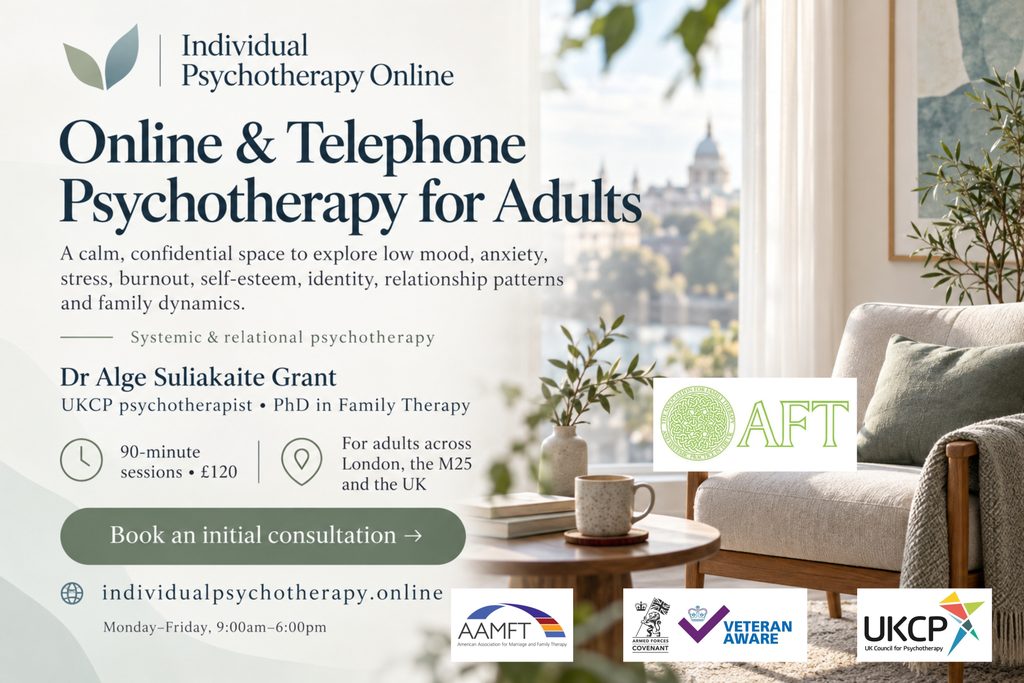
Standard ongoing psychotherapy session.
Per standard ongoing 90-minute session.
Adult individual psychotherapy.
9:00am–6:00pm, subject to availability.
A 90-minute session length does not determine how many sessions someone will attend.
View Fees & AppointmentsBefore ongoing psychotherapy
Can duration be discussed in the initial consultation?
Yes.
The initial consultation can provide an opportunity to discuss what you are hoping to explore and ask how duration and frequency are usually approached.
It may still not be possible to predict an exact number of sessions before the work has begun.
Before starting
Questions to ask about duration before starting psychotherapy
Do you work on a fixed-term or open-ended basis?
How often do you usually meet?
How is progress reviewed?
How would we discuss whether to continue?
Can session frequency change?
How do endings usually work?
What happens if I decide I want to stop?
Is there any minimum commitment?
How long is each session?
What is the fee?
Scope & suitability
When another service may be more appropriate
General individual psychotherapy is not always the right service for every situation.
A different service may be more appropriate where someone requires urgent intervention, condition-specific structured treatment, psychiatric assessment, specialist trauma treatment or emergency mental-health support.
Individual Psychotherapy Online is not an emergency or crisis service.
View urgent help informationQuestions
Questions about psychotherapy duration
How long does psychotherapy take?
There is no universal duration. Some psychotherapy is relatively focused and shorter-term, while other work continues for longer where someone wants to explore long-standing emotional, relational or contextual patterns.
How many psychotherapy sessions will I need?
It is often not possible to predict an exact number of sessions before psychotherapy has begun. Duration depends on the concern, therapeutic approach, frequency, circumstances and how the work develops.
How often are psychotherapy sessions?
Session frequency varies between therapists and therapeutic approaches. Weekly sessions are common in many forms of psychotherapy, but other frequencies may also be agreed depending on the work and circumstances.
Is weekly psychotherapy normal?
Weekly psychotherapy is common in many approaches because it can provide continuity and a predictable rhythm. It is not, however, a universal requirement.
Can psychotherapy be fortnightly?
Fortnightly psychotherapy may be possible in some circumstances, although longer gaps can affect continuity in some forms of work. Frequency should be discussed with the therapist rather than assumed.
What is short-term psychotherapy?
Shorter-term psychotherapy usually has a more defined focus and a more contained anticipated duration. There is no single number of sessions that defines short-term therapy across all approaches.
What is long-term psychotherapy?
Longer-term psychotherapy may be relevant when someone wants to explore long-standing patterns, relationships, family experiences or identity over time. It should still be possible to review whether continuing remains useful.
Is long-term psychotherapy better?
No. Longer psychotherapy is not automatically better, and shorter psychotherapy is not automatically more efficient. Appropriate duration depends on the person, purpose, approach and context.
Do I need to commit to a fixed number of sessions?
Some psychotherapy is explicitly time-limited, while other work is open-ended and reviewed over time. Ask the therapist what arrangement they offer and whether any minimum commitment applies.
How do I know whether therapy is helping?
Progress may involve greater understanding, recognising patterns earlier, clearer choices, different conversations, changes in boundaries or reductions in the intensity of a particular difficulty. Change may be gradual and uneven.
Can I ask to review therapy?
Yes. It is reasonable to ask how the therapy is going, whether the focus has changed, whether continuing is useful and whether session frequency or an ending should be discussed.
Can I stop psychotherapy whenever I want?
You can decide to stop psychotherapy. Where possible, discussing that decision with the therapist can help clarify what has changed, what remains important and any practical arrangements around ending.
How do psychotherapy endings work?
An ending may involve reviewing what changed, what remains difficult, how you want to manage future challenges and what the ending itself means. There is no requirement for every difficulty to be completely resolved first.
Can I return to psychotherapy later?
It may be possible to return to psychotherapy later, subject to therapist availability, suitability and current circumstances.
How long are sessions at this practice?
Standard ongoing sessions at Individual Psychotherapy Online are 90 minutes.
How much does a session cost?
The standard ongoing fee is £120 for a 90-minute psychotherapy session.
Continue reading
Related psychotherapy information
Considering psychotherapy
You do not need to know the exact duration before you begin
An initial consultation can provide an opportunity to discuss what is bringing you to psychotherapy, what you hope to explore and how duration, frequency and practical arrangements might be approached. It may not be possible to predict an exact number of sessions before the work has begun.